December labour demand was lower than in previous years but labour shortages are still supporting activity – REC
January 16, 2024

December labour demand was lower than in previous years but labour shortages are still supporting activity – REC 


  • The number of active postings in the month of December 2023 was 1,710,492, a 24.3% decrease from the month before (November 2023) and a 32% decrease from December 2022 (2,516,973). There were 2.8 million active vacancies in the month of December 2021.
  • Notable increases in adverts for prison service officers (+34.7%), authors, writers, and translators (+10.3%) and air transport operatives (+4%).
  • In December 2023 Tower Hamlets (-7.7%), Haringey and Islington (-11.0%) and the Orkney Islands (-12.0%) had the softest decline in job postings when compared to November 2023.
  • There were 656,481 new job postings in December 2023 – a 27.7% decrease from the month before and a 27% decrease from December 2022 (899,049).

Despite falls relative to previous years, demand overall is still substantial, with the latest Recruitment & Employment Confederation (REC) and Lightcast Labour Market Tracker showing 1.7 million active job postings in December.


December is always a quiet month for recruitment, as Christmas hiring is generally completed and clients tend to postpone new activity into January, so the fall in posting numbers from November is no surprise. By contrast, the like-for-like comparison with the previous two Decembers, which came amid the post-pandemic sugar rush of hiring, emphasise the sequential slowing of the market in 2023.


REC Chief Executive Neil Carberry said:


“It is little surprise that jobs postings were muted in December because employers tend to have completed Christmas hiring by November, and then postpone new activity until the new year.


“The labour market weakened across 2023, especially for permanent roles. But it did so from a very high base. Comparing with previous Decembers, we can see a significant fall from the levels of activity in previous post-pandemic festive periods. It is important to remember that activity levels overall remain relatively high by comparison to pre-pandemic norms, and unemployment is low. There remains opportunity out there for jobseekers, especially in growing sectors.

“Anecdote and client survey data suggests there is hope for more growth in the market this year. As the economy grows, businesses will be looking to government to use the Spring Budget to unlock labour supply with action from welfare-to-work programmes to skills reform and a more sensible debate on immigration.”


Neil Carberry added:


“Uncertainty about the economy this year means we must make sure we support young people as they leave education. This must include rethinking the Apprenticeship Levy to re-focus levy money on 16–24-year-olds and those most in need – and more flexibility so that businesses can use it for high quality shorter training courses that will help plus skills gaps.”
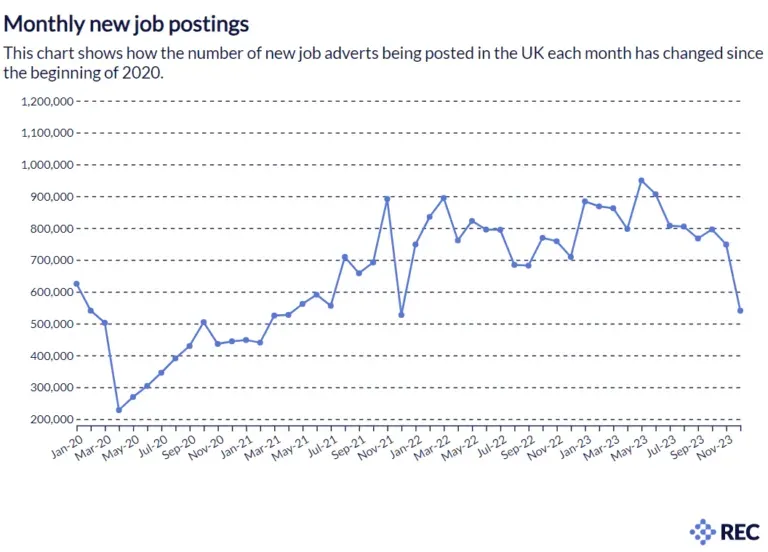
A graph showing the number of new job postings in the uk

Occupations with notable increases in adverts in December 2023 include prison service officers (+34.7%), authors, writers, and translators (+10.3%), air transport operatives (+4%) and speech and language therapists (+3.0%). Psychotherapists and cognitive behavioural therapists (-3.7%), dental nurses (-6.4%) and childminders (-6.6%) follow with the softest declines in job postings this month.


Manual labour roles were not particularly in demand during the December timeframe, with painters and decorators (-41.1%), packers, bottlers, canners and fillers (-40.5%) and road transport drivers (-40.2%) showing the lowest growth in job adverts.


When looking at the top ten counties/unitary authorities for growth in active job postings, five were based in London. This suggests a more encouraging trend for the capital’s job market and economy than reported in alternative recent jobs surveys.


Of the bottom ten areas with the lowest growth in active job postings, five were in Scotland and four were in Northern Ireland. This chimes with the REC/KPMG Scotland Report on Jobs which found that overall demand for staff weakened further, with both permanent and temp vacancies declining markedly in December.


Across the UK, Tower Hamlets (-7.7%), Haringey and Islington (-11.0%) and Orkney Islands (-12.0%) had the softest decline in job postings when compared to November 2023. Belfast (-34.2%), Fermanagh and Omagh (-34.3%) and East Dunbartonshire (-41.5%) all accounted for the sharpest decline in job postings. 


Ends


Notes to editors:


  1. The REC has been analysing weekly and monthly data comparisons in parallel for the final months of 2023 to assess ways of improving the robustness of our analysis. Consequently, we will switch to comparing monthly rather than weekly data on a permanent basis from January 2024.


The LMT will also move from analysing Standard Occupational Classification (SOC) 2010 to the revised SOC 2020. The main areas of change from the previous classification are:


  1. A review of the classification of roles as professional or associate professional
    This means that occupations such as Paramedics, Multimedia Designers, Investment Analysts, and Taxation Experts, which were part of the “Associate Professional or Technical” classification in SOC 2010, have been reclassified as “Professional” occupations in SOC 2020.
  2. The reclassification of occupations associated with information technologies
    This means that the growth in IT roles over the last decade or so has now been recognised by the creation of new unit groups such as Cyber Security, Quality and Testing, Networks, Web Design, Database Administrators, and IT Trainers.
  3. Disaggregation into less heterogenous unit groups
    This includes the creation of a separate role for Logistics Management; distinguishing General Medical Practitioners from Specialist Medical Practitioners; a breakdown of nursing roles; and more detail on storage and warehouse roles.
  4. Overall, the new SOC 2020 classification system is more granular, with 43 more occupations at the 4-digit level than the 2010 version. This means that the REC can provide better and more up-to-date information, based on both the 43 the new classifications and the reviewed classifications.


  1. The Labour Market Tracker is produced by the REC in partnership with Lightcast, using their Job Postings Analytics data which is harvested from tens of thousands of job boards. Data was harvested in December 2023. For more details, see the attached annexes which, in league table format, detail the top and bottom ten county/unitary authorities for growth in job postings and growth by occupation type.


  1. ‘Active’ job postings are those which were live online during the specified time period. ‘New’ job postings are those which were added to the active stock during the specified time period.

By Simon Bliss August 25, 2026
The latest UK employment data makes uncomfortable reading for the recruitment sector, but it also reinforces why independent recruitment businesses need to work differently in today's market. According to the latest Adzuna UK Job Market Report, reported by Staffing Industry Analysts, the number of UK vacancies stood at 791,490 in July 2026, down 9.6% year-on-year. This represents a reversal of some of the gradual improvement seen earlier in the year and confirms what many recruiters are already experiencing: there are fewer vacancies to compete for and clients remain cautious about hiring. However, the headline figure doesn't tell the whole story, there are still areas of growth Several important sectors continue to expand: Teaching vacancies increased 11.9% year-on-year Trade & Construction increased 8.3% Manufacturing increased 2.2% Travel vacancies increased 348% Meanwhile, average advertised salaries remain 3.01% higher than a year ago at £43,675. IT continues to command the highest average salaries at £67,771, up 16.8% annually, while salary growth was also strong in Sales (+11.3%), HR & Recruitment (+9.8%) and Consultancy (+9.5%). So while overall hiring demand has reduced, there are still sectors, skills and individual employers where significant recruitment opportunities exist. A smaller market makes every opportunity more valuable for independent recruitment businesses, perhaps the most important lesson isn't simply that there are fewer jobs. It's that every job, candidate and client relationship has become more valuable. When vacancies were plentiful, recruiters could afford to walk away from a role outside their specialism, geography or candidate network. In today's market, that is potentially lost revenue. Similarly, recruiters may already have excellent candidates sitting within their databases for whom they don't currently have a suitable vacancy, that creates a strong argument for collaboration. The TEAM Advantage: TEAM was built around the principle that independent recruitment businesses can achieve more by working together while retaining their independence. Through TEAM Xchange, members can share vacancies and candidates with other trusted recruitment businesses. If one member has the vacancy and another has the right candidate, they can make the placement together and share the fee. Last year, TEAM members shared £10.4 million in recruitment fees through TEAM Xchange. In a market where vacancies are down 9.6%, the ability to access opportunities beyond your own individual client base becomes increasingly important. Instead of saying: "We can't fill that." or: "We don't recruit in that sector." a TEAM member has the opportunity to ask: "Could another TEAM member help us make this placement?" Likewise, a strong candidate who cannot currently be placed with your own clients may be exactly what another TEAM member needs. Smaller recruiters can remain agile, t here is another reason for optimism. Challenging markets often reward businesses that can move quickly. Independent recruiters typically have fewer layers of management, closer client relationships and the ability to specialise deeply in particular markets. Combine that agility with access to a wider recruitment community and suddenly a small recruitment business can have considerably greater reach than its headcount might suggest. TEAM members can draw upon fellow specialists across multiple sectors, regions and disciplines rather than trying to build every capability internally. That means remaining independent without having to operate alone. Focus on what you can control and n obody can control the overall number of UK vacancies. Recruitment business owners can, however, control how effectively they exploit the opportunities that remain. That means: Specialising – Know where your expertise genuinely adds value. Collaborating – Don't automatically turn away vacancies or candidates you can't service yourself. Working your candidate database – Great candidates already known to you are valuable assets. Expanding client conversations – Understand where clients are still hiring and where skills remain difficult to find. Using your network – Access knowledge, candidates, jobs and expertise beyond your own business. Protecting margins – In a more competitive market, quality and specialist expertise matter more than competing purely on price. Tough market. Different opportunity. The July figures show that UK recruitment remains challenging. Graduate recruitment is particularly difficult, with vacancies falling 45.6% year-on-year to a record low of 8,383, while several major sectors continue to experience significant reductions in hiring. But there are still almost 800,000 advertised vacancies across the UK, salaries continue to rise annually and several sectors are growing. For independent recruiters, the objective isn't to wait for the market to return to the conditions of a few years ago, it's to adapt to the market we have today. At TEAM, we believe collaboration is one of the ways independent recruiters can do exactly that: sharing opportunities, accessing specialist expertise and helping each other make placements that might otherwise have been lost. In a market with fewer jobs, making more of every opportunity matters more than ever.
By Andy Dunne August 21, 2026
TEAM Membership over 2 months: Four permanent invoices, one temp placement and nearly £10,000 in split fees.
By Andy Dunne August 14, 2026
I’ve finally broken the 2 million LinkedIn impressions marker in 365 days.
By Andy Dunne August 5, 2026
Why TEAM chose WTT, and why I believe it's one of the biggest enhancements to Membership we've ever made
TEAMBlog webinar banner with blue geometric background and title, โ€œWhy the Best Independent Recruiters Donโ€™t Go It Alone.โ€
By Simon Bliss July 30, 2026
Collaboration isn't giving something away, it's creating opportunities you could never win on your own.
By Partners& June 9, 2026
At a time when recruitment businesses are faced with myriad challenges, the fact that Partners& has joined the TEAM Network is welcome news. Partners& is an award winning insurance advisory business committed to collaborating with clients to help them protect their business and build lasting resilience.
By Simon Bliss June 9, 2026
In Clifton Diocese (“the Diocese”) v Parker [2026], the Employment Appeal Tribunal (“EAT”) considered whether the burden of proof test was being misapplied in respect of a religion or belief discrimination case and confirmed the legal approach to be taken. This case also highlighted deficiencies with the employer’s process, escalation of initial performance concerns and the sanction applied. Read on for further details of why this case is important, especially for employers dealing with performance issues and conducting formal processes.
By Simon Bliss April 30, 2026
On 7 April 2026, the Fair Work Agency (“FWA”) was established as an executive agency of the Department for Business and Trade. Its creation marks a significant shift in how worker protections are enforced, by bringing together multiple enforcement functions which were previously exercised by multiple bodies.
By Simon Bliss April 9, 2026
In Dobson v North Cumbria Integrated Care NHS Foundation Trust (the “Trust”), the Employment Tribunal considered whether the Trust’s policy of requiring all community nurses to be available to work flexibly, including at weekends, amounted to indirect sex discrimination.
New Acas Survey on the Employment Rights Act 2025
March 3, 2026
New Acas Survey on the Employment Rights Act 2025