REC Members Approve New Chair at Successful Annual General Meeting
Rachel Torrens • June 22, 2023

The Recruitment & Employment Confederation (REC) is pleased to announce Michelle Mellor will take over as its new Chair later in the year.


Michelle Mellor is founder and director of Cummins Mellor and was voted to replace the existing Chair when their term ends in October. The vote was carried through at the REC’s AGM held today, where members reviewed a successful year for the business in 2022.


Michelle has been a non-executive Director & Council Member of REC since 2017. A former chef, her company Cummins Mellor has been an REC member for more than 30 years.


Michelle Mellor, Chair-designate of the REC, said:


“I am delighted to be elected as Chair of the REC and hope to build on its reputation as an influential, dynamic and member-focussed organisation. I passionately believe that recruiters are a force for good in contributing to people’s careers, professional development and wellbeing. I will bring my insight and eagerness on flexible working and equal opportunities to the role of Chair, as our industry moves into the next stage of the post-pandemic era.


“The REC is all about its members who play an incredibly crucial role in the UK economy, in people’s careers and in business. I look to championing the work our members do every day and to also elevate equity, inclusivity and connectivity in the recruitment industry because if your people are growing and thriving then so is your organisation.”


Sarah Thewlis, Chair of the REC until October 2023, and Managing Director at Thewlis Graham Associates, said:


“The AGM’s approval of Michelle Mellor as Chair is a moment to celebrate. I have worked with Michelle for many years as part of the REC. I have always been impressed by her commitment to the recruitment industry and the role it plays in making such a difference to businesses and individuals. I have witnessed at first hand her passion, thoughtfulness, and integrity. The Board will be in great hands when she takes over in October.”


Neil Carberry, Chief Executive of the REC, said:


“Michelle’s extensive experience of recruitment, her entrepreneurialism and energy have been a huge asset to our organisation over her years on the Council and Board, and I look forward to this continuing. A good Chair is a huge asset to any organisation and we have been well served in this regard by Sarah over the past three years. I look forward to building on this in partnership with Michelle over the next three years.”


Commenting on the performance of the REC in 2022, Neil added:


“The REC saw strong revenue growth in 2022, based on additional services offered to members as they grew their businesses in what was a robust year for our sector. As members would expect, we put all of this additional income into member-focussed services. Building on this, the REC has had a strong start to 2023 and we look forward to moving into our new home next month, which will offer a better working environment for our team, and better value for members.”

By Simon Bliss • August 25, 2026
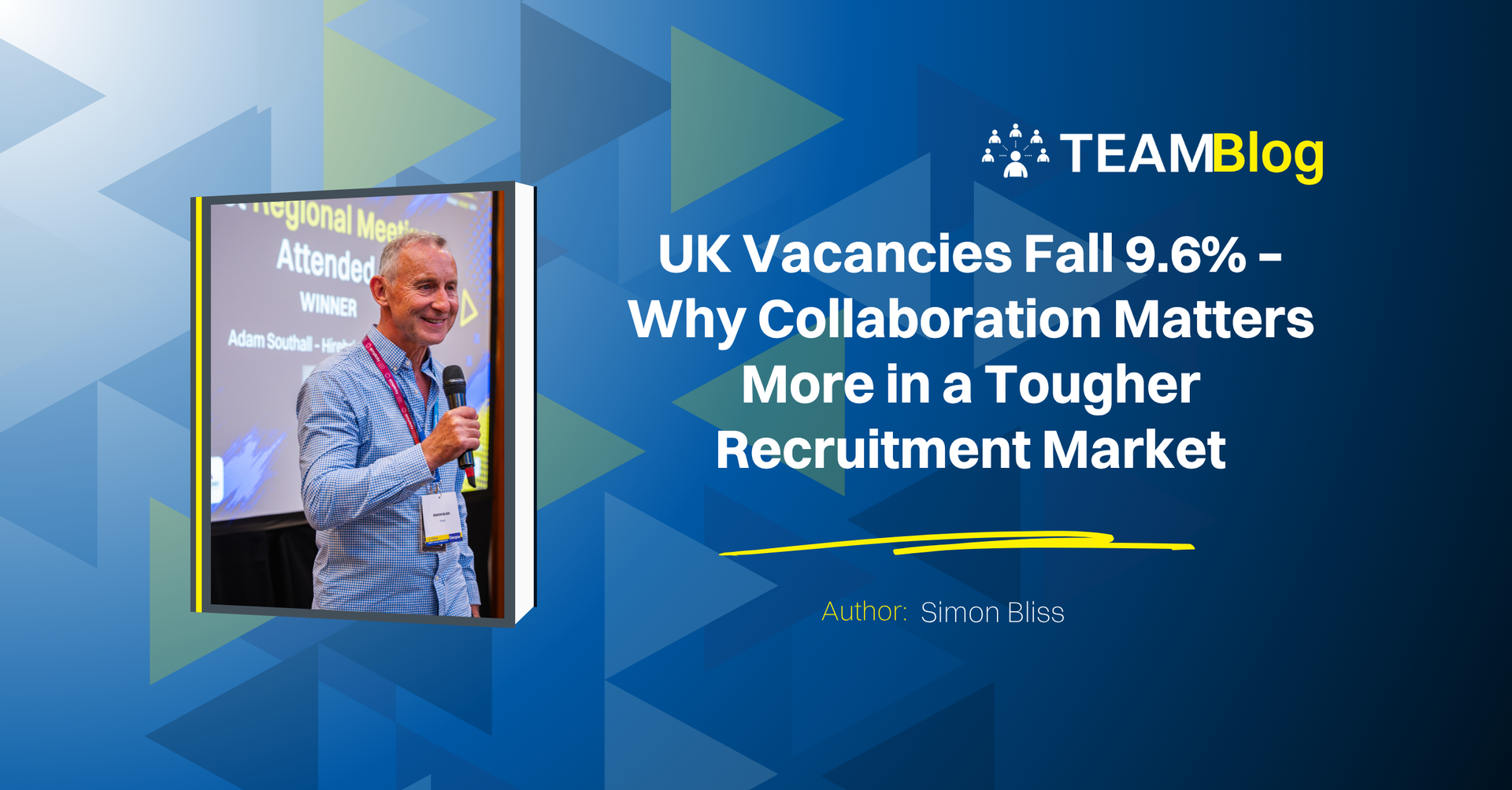
The latest UK employment data makes uncomfortable reading for the recruitment sector, but it also reinforces why independent recruitment businesses need to work differently in today's market. According to the latest Adzuna UK Job Market Report, reported by Staffing Industry Analysts, the number of UK vacancies stood at 791,490 in July 2026, down 9.6% year-on-year. This represents a reversal of some of the gradual improvement seen earlier in the year and confirms what many recruiters are already experiencing: there are fewer vacancies to compete for and clients remain cautious about hiring. However, the headline figure doesn't tell the whole story, there are still areas of growth Several important sectors continue to expand: Teaching vacancies increased 11.9% year-on-year Trade & Construction increased 8.3% Manufacturing increased 2.2% Travel vacancies increased 348% Meanwhile, average advertised salaries remain 3.01% higher than a year ago at £43,675. IT continues to command the highest average salaries at £67,771, up 16.8% annually, while salary growth was also strong in Sales (+11.3%), HR & Recruitment (+9.8%) and Consultancy (+9.5%). So while overall hiring demand has reduced, there are still sectors, skills and individual employers where significant recruitment opportunities exist. A smaller market makes every opportunity more valuable for independent recruitment businesses, perhaps the most important lesson isn't simply that there are fewer jobs. It's that every job, candidate and client relationship has become more valuable. When vacancies were plentiful, recruiters could afford to walk away from a role outside their specialism, geography or candidate network. In today's market, that is potentially lost revenue. Similarly, recruiters may already have excellent candidates sitting within their databases for whom they don't currently have a suitable vacancy, that creates a strong argument for collaboration. The TEAM Advantage: TEAM was built around the principle that independent recruitment businesses can achieve more by working together while retaining their independence. Through TEAM Xchange, members can share vacancies and candidates with other trusted recruitment businesses. If one member has the vacancy and another has the right candidate, they can make the placement together and share the fee. Last year, TEAM members shared £10.4 million in recruitment fees through TEAM Xchange. In a market where vacancies are down 9.6%, the ability to access opportunities beyond your own individual client base becomes increasingly important. Instead of saying: "We can't fill that." or: "We don't recruit in that sector." a TEAM member has the opportunity to ask: "Could another TEAM member help us make this placement?" Likewise, a strong candidate who cannot currently be placed with your own clients may be exactly what another TEAM member needs. Smaller recruiters can remain agile, t here is another reason for optimism. Challenging markets often reward businesses that can move quickly. Independent recruiters typically have fewer layers of management, closer client relationships and the ability to specialise deeply in particular markets. Combine that agility with access to a wider recruitment community and suddenly a small recruitment business can have considerably greater reach than its headcount might suggest. TEAM members can draw upon fellow specialists across multiple sectors, regions and disciplines rather than trying to build every capability internally. That means remaining independent without having to operate alone. Focus on what you can control and n obody can control the overall number of UK vacancies. Recruitment business owners can, however, control how effectively they exploit the opportunities that remain. That means: Specialising – Know where your expertise genuinely adds value. Collaborating – Don't automatically turn away vacancies or candidates you can't service yourself. Working your candidate database – Great candidates already known to you are valuable assets. Expanding client conversations – Understand where clients are still hiring and where skills remain difficult to find. Using your network – Access knowledge, candidates, jobs and expertise beyond your own business. Protecting margins – In a more competitive market, quality and specialist expertise matter more than competing purely on price. Tough market. Different opportunity. The July figures show that UK recruitment remains challenging. Graduate recruitment is particularly difficult, with vacancies falling 45.6% year-on-year to a record low of 8,383, while several major sectors continue to experience significant reductions in hiring. But there are still almost 800,000 advertised vacancies across the UK, salaries continue to rise annually and several sectors are growing. For independent recruiters, the objective isn't to wait for the market to return to the conditions of a few years ago, it's to adapt to the market we have today. At TEAM, we believe collaboration is one of the ways independent recruiters can do exactly that: sharing opportunities, accessing specialist expertise and helping each other make placements that might otherwise have been lost. In a market with fewer jobs, making more of every opportunity matters more than ever.
By Andy Dunne • August 21, 2026
TEAM Membership over 2 months: Four permanent invoices, one temp placement and nearly £10,000 in split fees.
By Andy Dunne • August 14, 2026
I’ve finally broken the 2 million LinkedIn impressions marker in 365 days.
By Andy Dunne • August 5, 2026
Why TEAM chose WTT, and why I believe it's one of the biggest enhancements to Membership we've ever made
TEAMBlog webinar banner with blue geometric background and title, “Why the Best Independent Recruiters Don’t Go It Alone.”
By Simon Bliss • July 30, 2026
Collaboration isn't giving something away, it's creating opportunities you could never win on your own.
By Partners& • June 9, 2026
At a time when recruitment businesses are faced with myriad challenges, the fact that Partners& has joined the TEAM Network is welcome news. Partners& is an award winning insurance advisory business committed to collaborating with clients to help them protect their business and build lasting resilience.
By Simon Bliss • June 9, 2026
In Clifton Diocese (“the Diocese”) v Parker [2026], the Employment Appeal Tribunal (“EAT”) considered whether the burden of proof test was being misapplied in respect of a religion or belief discrimination case and confirmed the legal approach to be taken. This case also highlighted deficiencies with the employer’s process, escalation of initial performance concerns and the sanction applied. Read on for further details of why this case is important, especially for employers dealing with performance issues and conducting formal processes.
By Simon Bliss • April 30, 2026
On 7 April 2026, the Fair Work Agency (“FWA”) was established as an executive agency of the Department for Business and Trade. Its creation marks a significant shift in how worker protections are enforced, by bringing together multiple enforcement functions which were previously exercised by multiple bodies.
By Simon Bliss • April 9, 2026
In Dobson v North Cumbria Integrated Care NHS Foundation Trust (the “Trust”), the Employment Tribunal considered whether the Trust’s policy of requiring all community nurses to be available to work flexibly, including at weekends, amounted to indirect sex discrimination.
New Acas Survey on the Employment Rights Act 2025
March 3, 2026
New Acas Survey on the Employment Rights Act 2025